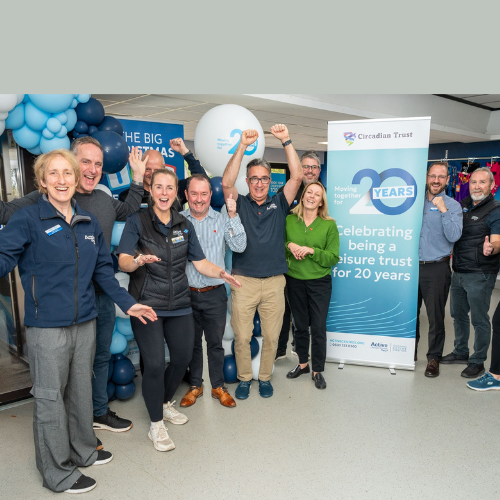
The charitable trust responsible for running South Gloucestershire’s five Active Lifestyle Centres is celebrating its 20th anniversary with a nod to the past and a vision for the future.
Circadian Trust was formed on 1 November 2005 when South Gloucestershire Council handed over the reins of its in-house leisure operation to the trust, a social enterprise operating as an independent charity, tasked with balancing commercial reality with social conscience, to deliver both commercial and social return on investment, within the local community.
Its not-for-profit status has enabled it to reinvest more than £16m in modernising services and facilities at its centres in Bradley Stoke, Kingswood, Longwell Green, Thornbury and Yate, including a £2.5m refurbishment programme for the gyms at all five centres, and £1m on rooftop solar panels to create electricity and subsidise energy costs.
Members and visitors will see the anniversary being celebrated with helium balloon displays, roller banners and bowls of sweets in each centre’s reception.
Behind the glitz, however, is a success story that has seen the trust:
CEO Mark Crutchley, who has been at the helm for all but six months of Circadian’s 20 years, has been reflecting on the evolution of the trust and shares some of his thoughts and insights here.
A commercial organisation with a social conscience
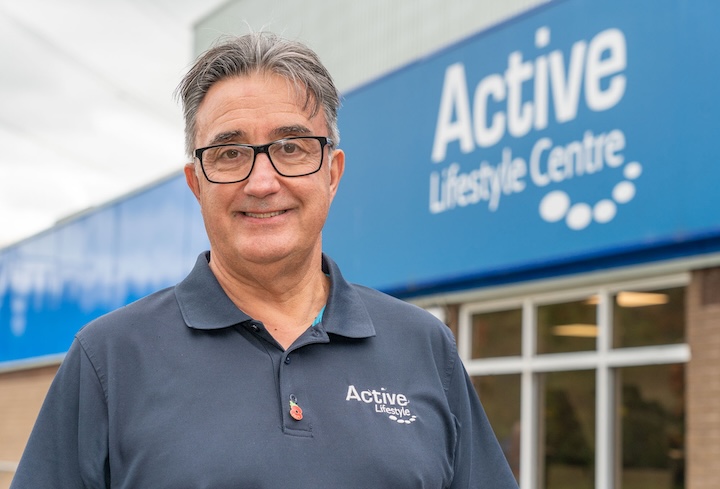
“I came into an organisation that wasn’t sure what it was after being an internal council department,” explains Mark. “We’ve had to shape the vision – several visions over 20 years in fact – to deliver congruent strategies that improve performance but also compliment stakeholders’ requirements.
“We had four fantastic gyms in the four leisure centres, and a fifth leisure centre under construction, but we had very little idea of how they should be run in a commercial way, but with a social conscience.
“There were 47 separate gym membership prices and swimming lessons were running across four sets of swimming pools with three different lengths of term. It was so confusing staff didn’t understand let alone customers.”
A huge rationalisation programme saw the number of memberships cut to just five and swimming lessons reduced to two durations – 10 and 12 weeks depending on the centre.
Has that changed the membership demographic over the 20 years?
“Proportionally, it hasn’t changed that much,” says Mark. “There is a bigger focus now on the deconditioned market, which wasn’t even a thing 20 years ago.
“Back then a third of our members were concessions – older, younger, disabled, people on benefits and students.
“At the moment, young people, which is under 24, is about 23% of the membership, 20% are over 55, 7% are 65 to 74 and 3% are 75 to 84, which means 47% are you might call the fitness fanatic category.
“We’ve always been different to the private sector because we offer concessionary prices because we’re a charity. The council offered quite heavy discounts before us, so we simplified the product and dropped the headline price.
“It’s taken some doing in terms of coalescence, shared understanding and a direction that is now seeing us pivot towards health and wellbeing and not just fitness.”
Keeping older people active for longer and making the inactive active
The most recent example of the pivot is community support days for people with musculoskeletal (MSK) conditions at Bradley Stoke and Thornbury Active Lifestyle Centres, giving patients access to healthcare professionals, such as physiotherapists, to help them manage their condition while fast-tracking anyone in need of further help and support.
“Very shortly one in five people in the UK will be over the age of 65,” says Mark. “When the state pension age was set at 65, the average life expectancy for a man was only three years longer than that.
“The NHS wasn’t designed to cope with a lot of people in their 80s and 90-plus with multiple health conditions that need a lot of care.
“That social shift means we have to ask how do we help keep older people active for longer, and make the inactive more active.
“It’s only now the NHS is writing prevention into their strategy, and it’s only now that councils are talking about outreach.
“We’re fully committed to that as a leisure trust, and we will work with them to deliver. It’s probably the best position we’ve ever been in because we know we’re not viewed as a contractor anymore. We’re viewed as a partner.”
The community support days initiative is a joint programme between Active Lifestyle Centres, healthcare partner Sirona Care and Health CIC and Bristol, North Somerset, and South Gloucestershire (BNSSG) NHS ICB. It also involves WorkWell, a free support service for anyone with a disability or health condition struggling with health barriers to employment.
“We’ve come from zero 20 years ago to having a team of five or six full time health specialists delivering in our leisure centres. That’s what’s underpinning the pivot we’re committed to,” adds Mark.
Coming through the existential crisis of the Covid-19 pandemic
Committing to the pivot is a position Mark and his team is glad to be in following the existential fears created by the Covid-19 pandemic, which he describes as the toughest time of his career.
He says: “I had more nights lying awake during the pandemic than any other time. We took what the government gave us and if Sport England hadn’t have given that money out after lots of campaigning in April 2021, just before we reopened, we probably wouldn’t be here today.
“And that’s what really rankles with me. Billions of pounds were poured into other sports virtually at the start of the pandemic yet public leisure centres, which is what ordinary people use, had to wait until 2021 to get a share of £100 million divided between all of us.
“It was tough. Every week you’re on Teams talking to the team and although you’re not lying, you’re hoping what you’re saying is true – that they’ve all got a job to come back to, that the services will restart. Literally in the middle of the pandemic, you didn’t know whether that was true or not.
“Then when we did come back, the reserves were almost exhausted, you’ve got no money. So, if something broke down, you’ve got a problem until you can build your cash flow back up.
“It’s testament to the team for rebuilding the business so quickly. We came through it, and I think we’ve got a business that is different but stronger as a result. It wasn’t all bad, we were able to with a lot of inefficiencies and programming foibles.”
Finally, Mark has mixed views on what the future holds.
“Any business that came through the pandemic is probably at its peak right now,” he says. “The point that I’m making is that leadership is about people. It’s about getting your people sailing in the same direction and sharing a vision.
“When you go through a crisis and then you’ve got recovery, everyone is roughly doing the same thing, just with different dials and different knobs turned up to different levels.
“As time goes by, we’ll return to the status quo and there will be good decisions and bad ones. We’ll get some fantastic successes, and we’ll get some spectacular failures.
“As a sector we need to be ready for any failures because the people who suffer, besides the workforce – which is an immediate and usually short-term thing – are the customers, those who rely on these services for their mental health and physical health.”
Circadian Trust offers a wide range of leisure facilities and services and is committed to making a positive difference to everyone within its local communities, providing a diverse, and inclusive environment for all.
Ends