We’re encouraging all political leaders, policy influencers and those involved in Local Government Reorganisation to take time out of your busy schedule over the next few months and visit the charity or social enterprise currently managing their local leisure and cultural services.
Why?
Because you’ll gain an even greater understanding and appreciation of the fabulous work of our membership and the real community impact they make.
Drop us an email if you’d like to pay any of our members a visit.
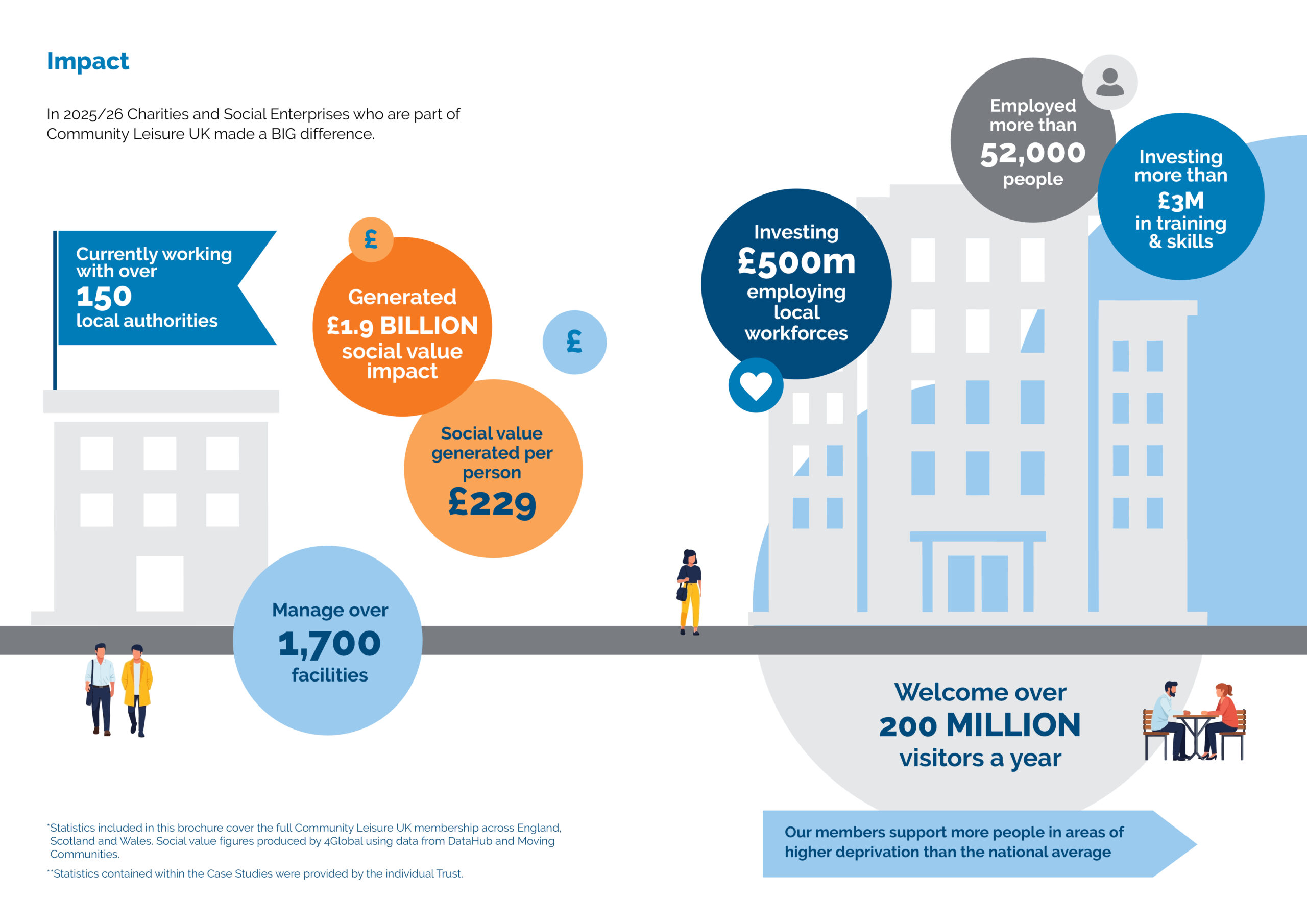
Leisure and culture trusts are committed to delivering high quality, accessible public leisure and culture services across the nation, offering a wide choice of activities and programmes for people to lead healthy and creative lives. They deliver an average social value per person of £229* (UK-wide) and are rooted in their local communities.
To support the development of place-based partnership arrangements that build on local strengths and meet local needs. Working in partnership will enable us to build a better, fairer, future for all.
There are two key differences between a Charitable Trust who manages public leisure and culture and the private sector and public sector approach.
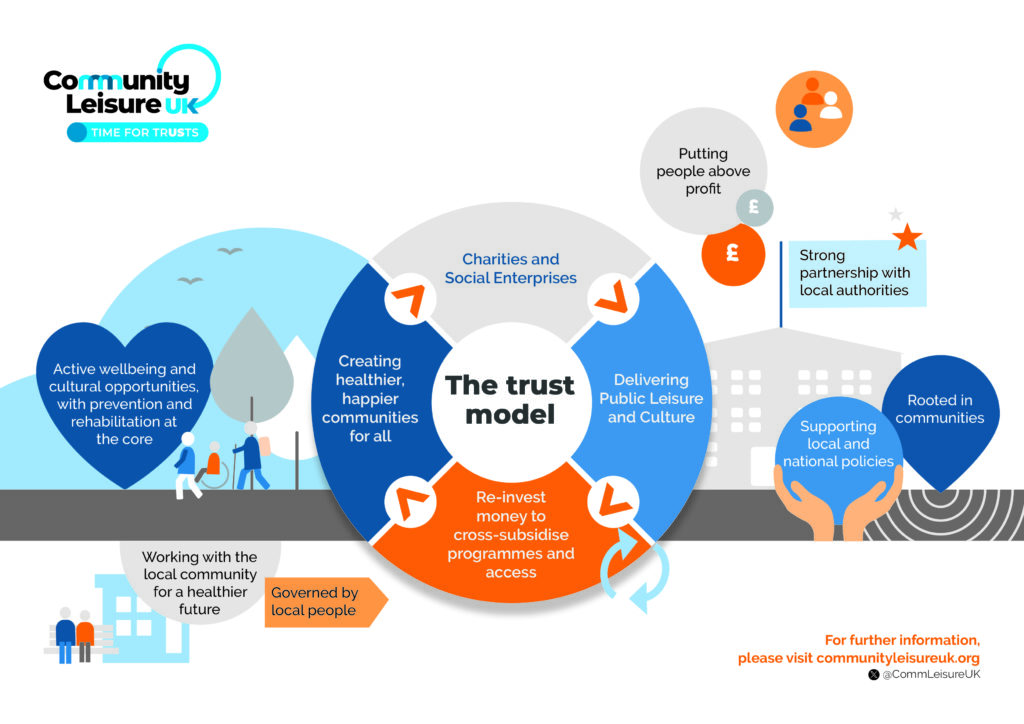
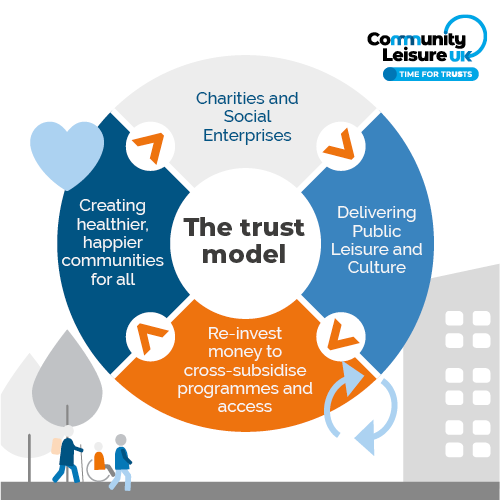
Their unique cross-subsidy approach means they can re-invest surpluses generated to help them achieve their goal of helping everyone to live healthier, happier lives. And they are governed by local people.
Community Leisure UK members typically have contracts for services with local authority partners to deliver across a breadth of leisure and culture services. The majority of our members are called a single-contract trust – in other words they deliver the services and manage the facilities on behalf of one, local authority partner.
A small number of members hold multiple contracts across England and Wales.
We also have a number of, predominantly smaller, members with no local authority relationship but who commonly have taken on a community asset transfer.
Our members make a huge difference to individual and community health outcomes. All 96 of our members across England, Wales and Scotland share a passion to improve social, mental and physical wellbeing. They believe in their social cause of putting people above profit and making a difference for everyone.
All members are leisure and culture trusts and are either registered charities or registered charitable societies.
Trusts do not distribute profit and instead reinvest every pound generated into the provision of quality leisure and culture services and facilities. Trusts are rooted in the local communities they serve, with specific services designed and supported through the cross-subsidy model to support those in most need.
Community Leisure UK members’ manage facilities including: swimming pools, libraries, museums, pitches, gyms, ice arenas, beach fronts, parks, heritage buildings and children’s centres. Importantly, members deliver vital community services such as exercise or books on prescription, short breaks for disabled children, adult social care support programmes, walking programmes, internet access courses, apprenticeships and training, and sports participation programmes.
As a members’ association, Community Leisure UK is responsible to its members and an appointed Board. The Board is made up of member trust Chief Executive Officers or Managing Directors who are democratically appointed by the membership.
Currently 43% of public leisure provision across England, 50% Wales and 85% across Scotland, use the trust model. The word ‘trust’ in this context refers to non-profit-distributing and independent organisations.
Trusts are legally constituted as:
Charitable Incorporated Organisations / Scottish Charitable Incorporated Organisation
Companies Limited by Guarantee with charitable status
Community Benefit Societies with charitable status
Community Interest Companies (CICs), or
The model of trusts, according to a survey carried out by Winckworth Sherwood (Trusts for Big Society, 2010)
“…enable individuals and communities to participate”.
The model of the trust focuses on utilising cross-subsidy, in two ways:
Importantly Winckworth Sherwood (Trusts for Big Society, 2010) note that;
Leisure and culture trusts contribute to and deliver across communities, reducing health inequalities, providing safe havens and spaces, and supporting and developing other local civil society organisations and stakeholders.
Increasingly trusts are the only social infrastructure in communities. Winckworth Sherwood (Trusts for Big Society, 2010) highlighted core advantages of the trust model
It spells out what trusts can and can’t do. For instance, they must invest or apply all surpluses to their charitable objectives. They are completely independent and do not distribute revenues or dividends to shareholders. Instead they invest or otherwise apply all surpluses to their charitable objective. You can read the full Charter here
If an organisation is not able to comply with our Charter of Integrity, then we would not consider them to be a genuine Charitable Trust.